


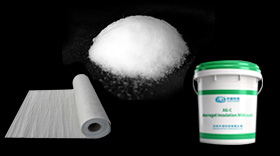
Aerogel+ Products All You Need for Thermal Insulation

Aerogel Insulation Material | China | Top Leading| China | Top Leading
Share
In building thermal insulation retrofit projects, traditional insulation mortar has been widely used for decades because of its low material cost and familiar construction process. However, modern buildings increasingly face challenges that traditional insulation systems struggle to solve, including limited installation space, facade renovation restrictions, thermal bridging, moisture-related performance loss, complex geometry, and long construction periods.
This is why aerogel thermal insulation coating is becoming an increasingly important alternative in thermal retrofit and exterior wall insulation applications.
Traditional insulation mortar improves thermal performance primarily through thickness. Its thermal resistance is calculated using: R value=thickness/thermal conductivity. Typical insulation mortar thermal conductivity ranges between 0.07–0.12 W/(m·K), which means thermal performance increases only when the insulation layer becomes thicker.
For example , their Thickness Typical Thermal Resistance is:
20 mm insulation mortar ~0.20-0.28 m²·K/W
30 mm insulation mortar ~0.30-0.42 m²·K/W
This explains why conventional exterior insulation systems often require 30-50 mm thickness with multiple layers to achieve thermal performance.
Although traditional insulation mortar remains widely used, it also creates several practical challenges.
First is it's Increased wall thickness. Exterior insulation systems significantly increase facade thickness, which can reduce usable indoor space, affect facade appearance and create retrofit difficulties. The Traditional insulation systems typically involve joints and anchors, where often become thermal bridges that reduce overall insulation performance.
Aerogel coating is not simply a thin insulation material, but functions as a comprehensive thermal barrier system. For instance, our AG-C aerogel thermal insulation coatings combine ultra-low thermal conductivity, solar reflection, infrared reflection, radiative heat blocking and seamless waterproof thermal protection. Unlike traditional insulation mortar, aerogel coating controls heat transfer directly at the surface which creates advantages that are difficult for thick bulk insulation systems to achieve.
One of the biggest misunderstandings about aerogel coating comes from using traditional conductive R-value calculations alone.
China addressed this issue through T/CECS 10126-2021,which evaluates aerogel coating using Guarded Hot Box Testing (GB/T 13475). This method measures actual system-level thermal performance under realistic operating conditions.
Independent testing shows that our AG-C aerogel coating applied at a thickness of 2 mm achieves a hot box tested thermal resistance of 0.21-0.36 m²·K/W, while traditional insulation mortar installed at 20 mm only delivers a thermal resistance of approximately 0.10 m²·K/W.
This demonstrates that thin aerogel coating can deliver thermal performance comparable to much thicker traditional insulation systems in real-world conditions.
Aerogel coating is especially suitable for old building renovation, facade energy upgrades and space-constrained structures.
It avoids the disadvantages of thick insulation systems by featuring minimal increase in wall thickness, faster installation, seamless application, easier treatment of corners and complex geometry, integrated waterproofing and insulation performance, and lower facade load, making aerogel coating well suited for buildings in hot climate regions.
Traditional insulation systems mainly slow conductive heat transfer after heat has already entered the wall, while aerogel coating reduces heat gain earlier by reflecting solar radiation at the surface.
Aerogel coating systems also provide long-term durability advantages. Because the coating forms a seamless monolithic layer, it avoids many common failure points found in traditional insulation systems which can reduce maintenance and lifecycle costs in long-term building operation.
Traditional insulation mortar remains an effective low-cost insulation material in many conventional projects. However, modern thermal retrofit applications increasingly require solutions that traditional thick insulation systems struggle to provide.
Aerogel coating offers a different approach. Rather than relying only on thickness, aerogel coating combines thermal insulation, solar reflection radiative heat blocking and seamless waterproof protection to create a thin yet highly effective thermal barrier system.
For space-constrained retrofit projects, exterior facade upgrades, and condensation-sensitive applications, aerogel coating is becoming one of the most practical modern thermal insulation solutions available.
Global Leader in Aerogel Materials & Advanced Composite Solutions
Back to Top
Copyright © 2025 Shenzhen Aerogel Technology Co., Ltd&Zhongning Technology(Hubei) Co.,Ltd
Power By Bontop
 English
 Korean