


Aerogel+ Products All You Need for Thermal Insulation

Aerogel Insulation Material | China | Top Leading| China | Top Leading
Share
For district heating project owners, EPC contractors, and on-site engineering teams, three persistent challenges erode project profitability and operational safety every heating season: uncontrolled heat loss, frequent insulation replacement, and costly Corrosion Under Insulation (CUI). For decades, rock wool and glass wool have been the default insulation choice due to low initial procurement costs. However, in the demanding environments of modern high-temperature networks, they consistently fail to solve core operational pain points.
This article breaks down how nanoporous aerogel thermal insulation blankets,compliant with ASTM C1728 standards, address these issues with proven ROI data and large-scale project validation.
Rock wool and glass wool have three universal, unresolvable limitations in district heating pipeline applications, particularly in underground trenches:
These soft fiber materials rely on chemical adhesives and binders to maintain their structure. After just 2-3 years of operation, the continuous pipeline vibration from hydraulic shock causes material settlement and structural sagging. This creates massive air gaps between the pipe and the insulation layer. This convective heat transfer "chimney effect" drives up heat loss exponentially. Globally, pipeline thermal waste accounts for up to 5% of total heat production, primarily due to failed traditional insulation.
The porous, "sponge-like" structure of rock wool and glass wool makes them highly moisture-absorbent. Even with temporary hydrophobic treatments, they eventually trap moisture against the steel pipe wall in humid underground environments. This leads to Corrosion Under Insulation (CUI)—a hidden oxidation process that causes eventual pipeline leakage. CUI is a leading cause of unplanned shutdowns and emergency repair costs, which can be 10x more expensive than scheduled maintenance.
With an effective functional service life of only 2-5 years, traditional materials require frequent replacement cycles. For underground pipelines, this means repeated confined space operations, which carry significant safety risks for personnel and drive up labor, material disposal, and reconstruction costs year after year.
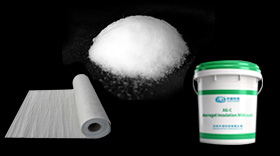
Aerogel thermal insulation blanket is a nanoporous, high-performance material designed specifically for industrial and district heating applications. It outperforms traditional materials in every critical metric, providing a "install and forget" solution.
Aerogel blankets feature an ultra-low thermal conductivity of 0.020 W/(m·K) at 25°C, which is less than half that of standard glass wool (0.048 W/m·K).
Engineering Example: For a DN800 primary heating pipeline with 150°C supply water, a 30mm thick aerogel blanket delivers significantly better insulation than a 60mm thick glass wool blanket.
Result: This reduction in thickness translates to 34.6% less heat loss, directly cutting fuel consumption at the boiler or heat source and lowering carbon emissions.
The financial benefits of switching to aerogel are quantifiable and highly compelling for project owners. Based on a 1000m DN800 district heating pipeline, the data shows:
Annual Energy Savings: 1291.4 GJ, equivalent to $90,400 USD.
Annual Maintenance Savings: $230,760 USD by eliminating frequent replacement cycles.
Total Annual Savings: $321,160 USD.
Incremental Investment Payback: Full recovery in 4.5 years.
10-Year Cumulative Profit: Approximately $1.77 million USD per kilometer of pipeline.
With a 10-20 year service life, aerogel eliminates more than 4 insulation replacement cycles over a decade, locking in long-term capital efficiency.
AG-F aerogel blanket and GJN Aerogel Blanket features a volume hydrophobic rate of over 99.6%, repelling liquid moisture even in harsh underground trench environments. Furthermore, it is completely chloride-free, eliminating the chemical root cause of steel pipe corrosion. This "breathable" but water-repellent layer extends the service life of your physical pipeline assets by decades.
Safety is paramount in urban infrastructure. Our material meets ASTM E84 Class A fire resistance standards, containing almost no organic content. It will not burn, support combustion, or release toxic fumes during installation or operation. Additionally, its durability drastically reduces the frequency of high-risk maintenance operations in hazardous underground spaces.
The performance of our aerogel blanket is not theoretical, it has been fully validated in one of the world's most demanding heating markets:
Project: Beijing Heating Group Northeast Third Ring Road Pipeline Renovation.
Scale: 4,587m of DN800 primary heating pipeline.
The Solution: 50mm aerogel blanket for supply pipes, 30mm for return pipes.
The Result: Stable operation for over 7 years, consistent 30%+ energy savings, zero reported CUI issues, and absolutely no insulation performance degradation since installation.
Aerogel thermal insulation blanket is the only solution that fully addresses the core pain points of the district heating industry. It cuts heat loss, reduces maintenance costs, prevents corrosion, and delivers a clear, fast return on investment.
For project owners and EPC contractors, it is not just an insulation material, but a strategic asset to improve project profitability and operational safety.
Contact our technical team today for a free customized insulation design and a full ROI calculation report tailored to your local energy costs.
Global Leader in Aerogel Materials & Advanced Composite Solutions
Back to Top
Copyright © 2025 Shenzhen Aerogel Technology Co., Ltd&Zhongning Technology(Hubei) Co.,Ltd
Power By Bontop
 English
 Korean