

Aerogel+ Products All You Need for Thermal Insulation

Aerogel Insulation Material | China | Top Leading| China | Top Leading
Share
At first glance, aerogel and fumed silica may look almost identical. Both appear as fine, white powders with a light, fluffy texture, and under a microscope, their nano-scale structures can seem surprisingly similar. Without checking the labels, even experienced material engineers might confuse them.
However, despite their similar appearance, aerogel and fumed silica have very different structures, properties, and industrial applications. Understanding these differences is essential for choosing the right material for thermal insulation, coatings, adhesives, or advanced industrial applications.
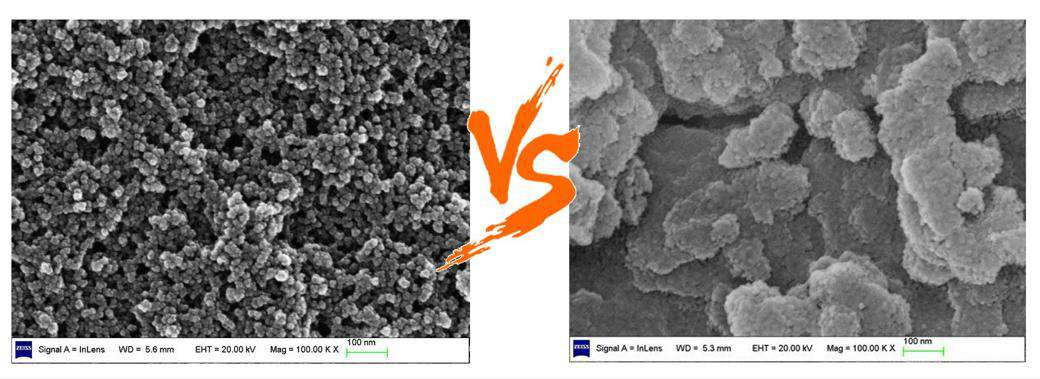
The primary difference between aerogel and fumed silica lies in their microscopic structure:
Fumed Silica consists of 10–20 nanometer primary particles that chemically bond into secondary aggregates, which further form loosely packed tertiary structures. The material has a porosity of 40–70%, and there is no continuous skeleton. This “particle pile” structure provides high surface area and reinforcement, but limits thermal insulation performance.
Aerogel, on the other hand, forms a three-dimensional continuous silica network with extremely high porosity (90–99.8%). Its solid framework is minimal, with densities as low as 0.005 g/cm³, lighter than air. The interconnected nanopores and continuous skeleton give aerogel its extraordinary thermal insulation and adsorption properties.
In short, fumed silica is optimized for structural reinforcement and rheology control, while aerogel is designed for high-performance thermal insulation and adsorption.
Aerogel
Aerogel’s thermal conductivity is typically 15–17 mW/m·K, lower than fumed silica’s 18–19 mW/m·K. While this difference seems small, it is critical in industrial applications where space and efficiency are limited. Aerogel allows for thinner layers to achieve effective insulation, making it ideal for:
High-temperature pipelines
Battery packs in electric vehicles
Building insulation and energy-efficient retrofits
Aerospace and advanced industrial applications
Aerogel’s large surface area (over 500 m²/g) and nanoporous structure also provide strong adsorption capabilities. Its primary focus remains high-performance insulation and fire protection.
Fumed Silica: Industrial Additive
Fumed silica is a versatile additive used to enhance product performance. Its main benefits include:
Improving tensile strength and abrasion resistance in rubber
Controlling viscosity and preventing pigment settling in coatings
Increasing bonding strength in adhesives
Its higher density (bulk density ~40 g/L) and aggregated particle structure make it easy to disperse and integrate into a wide range of formulations. Fumed silica is widely used in industrial coatings, adhesives, rubber products, and general chemical applications.
When incorporated into pastes or coatings, differences between aerogel and fumed silica become even more pronounced.
Fumed silica pastes tend to settle, show surface powdering after a few days, and may crack after drying due to shrinkage of 34–44%.
Aerogel pastes remain stable for months, can be re-mixed after slight settling, and form crack-free coatings with minimal shrinkage (4–10%).
These properties make aerogel the preferred material for high-performance thermal insulation coatings and pastes, while fumed silica is better suited for general-purpose coatings where reinforcement and rheology adjustment are required.
While aerogel and fumed silica may look almost identical at first glance, their microscopic structures and industrial roles are fundamentally different. Fumed silica excels at reinforcement, viscosity control, and general-purpose additive functions, whereas aerogel stands out in high-performance thermal insulation, fire protection, and advanced coating applications. Knowing how these materials differ helps you choose the one that truly fits your project, rather than just relying on appearances.
Global Leader in Aerogel Materials & Advanced Composite Solutions
Back to Top
Copyright © 2025 Shenzhen Aerogel Technology Co., Ltd&Zhongning Technology(Hubei) Co.,Ltd
Power By Bontop

 English
 Korean